
This post continues my thoughts about students’ bookwork and methods in Maths. Part one, about the trialling of separate exercise and notes books, is here.
I think the quality of students’ mathematical communication is often overlooked. In Wales, students “organisation, communication and accuracy in writing” (OCW) is assessed in one specific question on their Maths (& Numeracy) GCSE papers. Two marks are available on this question which is marked for its maths and OCW separately. Examiners look for;
- Labels describing what students are doing at each step of their working
- Well-structured working that is clear and logical
- Units
- Correct mathematical form
- Few, if any, errors in their spelling, punctuation and grammar
- A brief conclusion
I don’t think anyone would disagree that the above list are all things we would want to see in students’ working, and not just for the one ‘OCW’ question. Students, as we know, often need persuading that mathematics is more than just getting the right answer. When this aspect was introduced a few years ago, some misinterpreted it as the need for paragraphs of explanation and long sentences. The guidance is quite clear that this is not the intention, and that labels, conclusions and any explanations should be brief.
I don’t teach much KS3 these days but I do have a few hours of a lovely Year 9 set 1. I gave them the following question at the beginning of a lesson with no further instructions

After a few minutes, we discussed the answer and I took some students’ books to show under a visualiser. Only then did I reveal that I was particularly looking for how students had structured and communicated their answer. Here are some examples of students’ solutions;
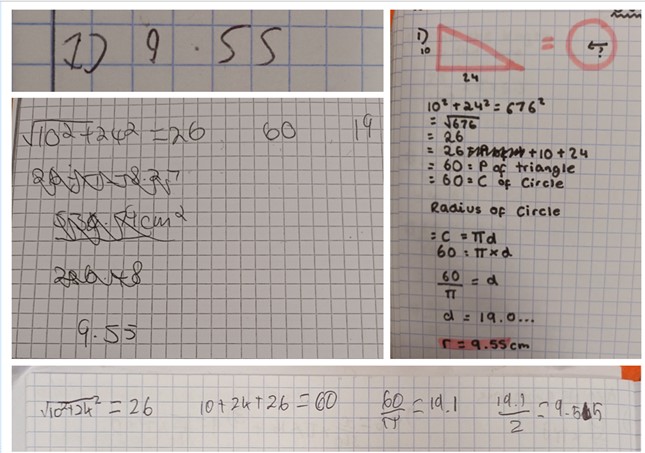
Look at the difference! Students of the same attainment given the same question, same time frame and just look at the difference! Why do bright students set out their work so poorly like this? Is it not realising the importance of mathematical communication? Laziness? Low teacher expectations of mathematical structure? Or something else? In my last blogpost, I argued that we are not looking for perfectly presented methods and want students to show rough workings, use diagrams, and occasional get things wrong. But, two (three?) of the methods seen above are not good enough as they are not communicating their maths, and can quickly become students’ norm unless they are challenged. Given that these students are in Year 9 and have been at my school for 3 years, it suggests that perhaps we aren’t doing enough to challenge this way of working.
For the rest of the lesson, I described and modelled what good OCW looks like, and talked through why the expectation of good mathematical communication is vital to their success in their studies, exam and in their future working life. Using a visualiser allowed powerful comparisons and discussions of what is good and bad mathematical communication. Towards the end of the lesson, students re-drafted their solution to the original problem. Here is one particularly staggering re-draft.
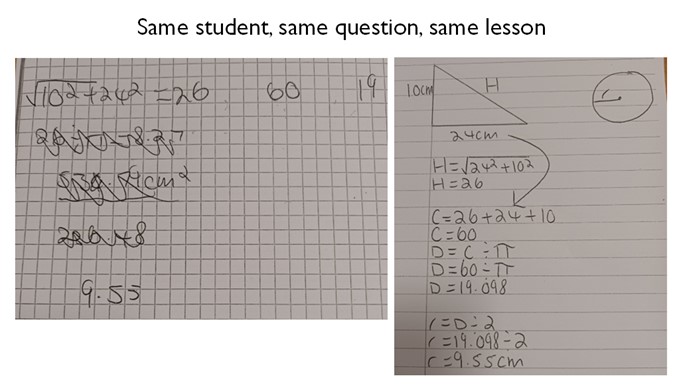
So they can do it! Whilst the response on the right isn’t absolutely perfect, I was amazed at the transformation. Whether this is a long term change or a one-off remains to be seen. I think high expectations are critical here and I am looking forward to teaching them again to reinforce what they learnt to hopefully recalibrate their attitude towards communicating their maths.

 Geomaths