What is the point of a maths exercise book? I’ve never been sure of the answer to this. A #mathscpdchat was hosted on this topic a few years ago:
“To support learning as good writing supports learning and allows for reduction in cognitive load by allowing for the page to substitute for working memory.” Pete Mattock, Maths lead and author
“To me, exercise books are a means to an end – they are merely a place for students to jot down workings in order to solve problems. It is the act of practising that’s important, not the written record of that practice. I’d happily have my students do all their work on scraps of paper that they throw away at the end of the lesson.” Jo Morgan (being provocative I think!), Resourceaholic
“Exactly as the name suggests. It is the same as an exercise yard – a place to perform exercises” Mark McCourt, LaSalle
“Which stakeholders view do you want? The student? The teacher? SLT? Parents? Governors? Ofsted? If you can get the same answer from all 6 then you’re doing well.” Mike Thain, Former Maths HoD
For my action enquiry project this year, I am looking at maths exercise books to try to determine what their purpose is. As a department, we have found that since COVID the presentation of students’ work had deteriorated. Colleagues in the department had different views as to how important presentation is, but we all did agree that books like the below were not acceptable.
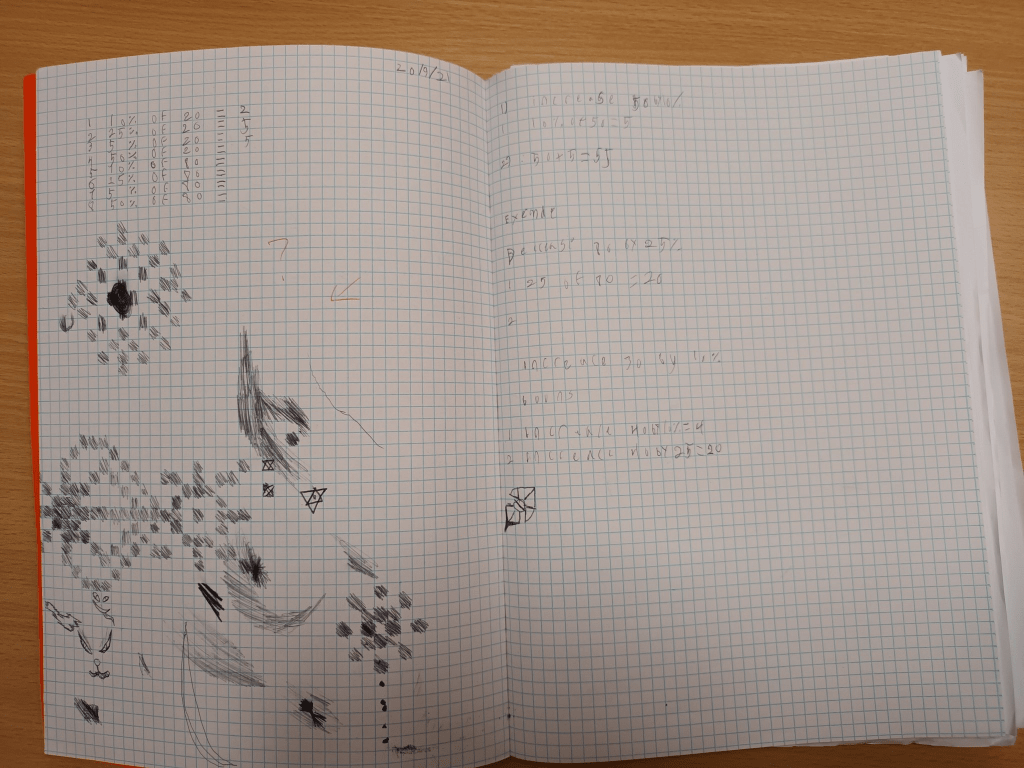
But maths can and perhaps should be messy at times. I like seeing mistakes, rough diagrams and students trying things on mini whiteboards and in their book. Does a book with nothing but perfect answers suggest that the exercises given are too easy? Why would students show their working, take risks, try different methods if we value presentation over mathematical thinking? We agreed as a team that we are not looking for such perfection, in the same way as we’re not looking for perfect handwriting with beautiful colours and highlighted text. The below is fine, but isn’t what we would now promote as best practice.
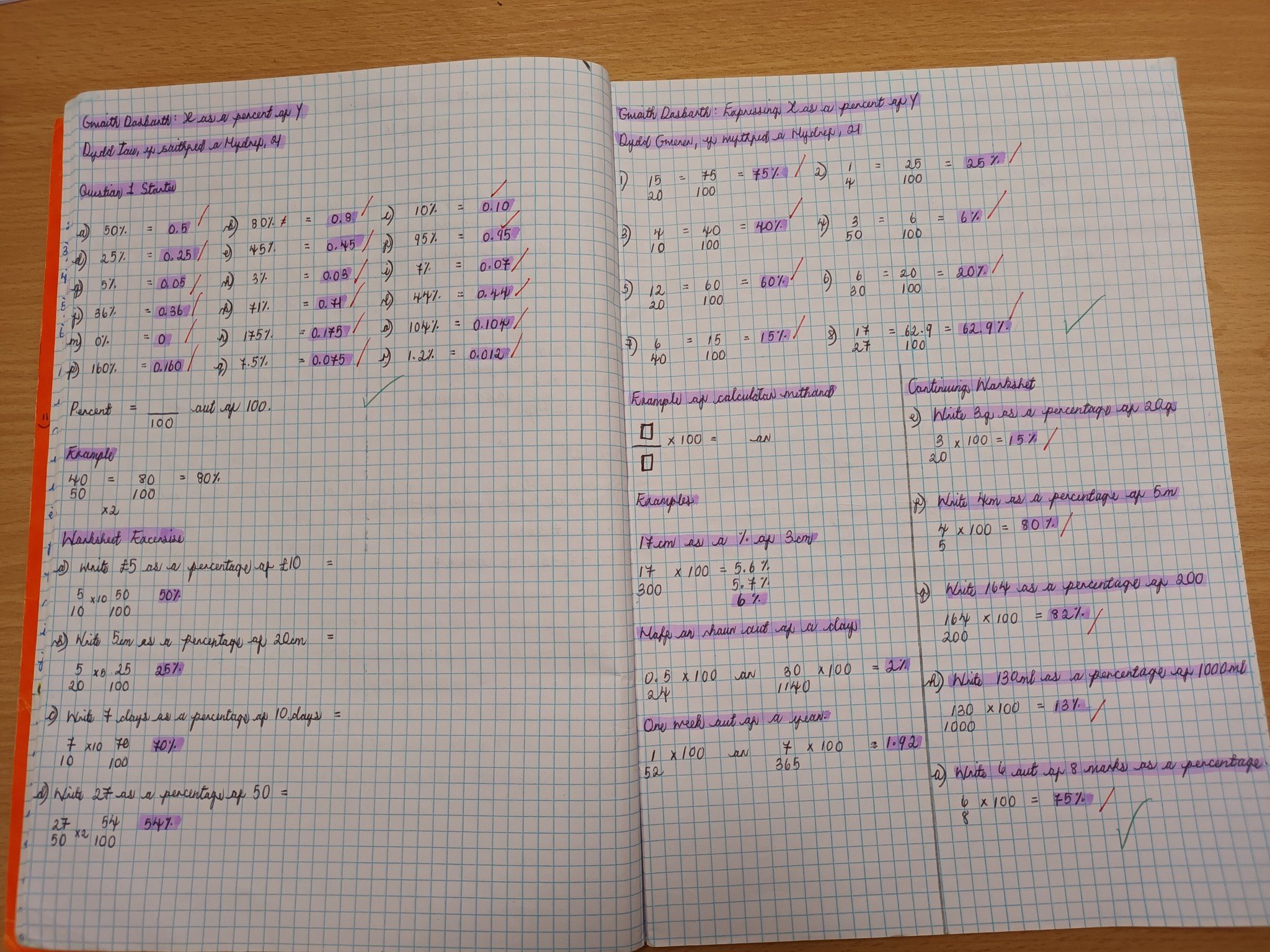
So, what do we want to see? What would best practice look like? Perhaps a brief list of things one would want to see in a book would include:
- Exercises
- Working out
- Formulae and other important things to remember
- All communicated in a legible manner, using accurate mathematical notation
I think it’s difficult to have all of the above in one book. It has always troubled me that students may write important formulae which they’ll need to revisit and remember, next to answers to an exercise which they probably won’t. One of my highest achieving 6th form students recently claimed that he’s never used his maths books/notes/folders for exam revision! So, this year I have had my Yr11 students (set 5 of 6) writing in two books; a large orange book for exercises, and a smaller red book for notes and formulae. I’ve asked them to keep their orange books for practice, rough working etc, and in their red book they’ve put worked examples, formulae, notes and key facts to remember.
Throughout the year I have taught the students how to take good notes and how to annotate worked examples in their red books. This took a fair bit of role modelling and scaffolding initially as note taking was not a skill that they had developed yet, and they also found it hard to decide between what should go in each book. However, they soon got the hang of it and were switching between the books without any fuss. In a typical lesson, after I role modelled an example, they would it down in their red books with annotations. This annotations part is important as it shows they grasp the idea, and it made the worked example more useful when revisiting the topic. I did not write down the annotations; students were encouraged to choose what and how to explain the steps. Students were also encouraged to spend time on this to do it neatly, knowing that extra effort to explain and present their work well would help them to understand the methods when revising. Good examples were then role modelled to the class using a visualiser. An example is below

Then, they would complete exercises in their orange book to practice, where I was less fussed about their presentation. So far, the trial has been an overwhelming success. Students’ red books are jam packed full of annotated worked examples, formulae, definitions, and key nuggets to remember. Students are very positive about their red books and are proud to show them off. Not only will they be an excellent source of revision for students, but they’ve also been very useful throughout the year to refer back to, to link topics, and to help students copy up notes if they’ve missed a lesson. I’d also like to think that students have developed their note-taking skills.
So I think I now know the answer to “What is the point of a maths exercise book?”. The answer is “which one?”

 Geomaths
1 Comment